Saturday, July 12, 2008

Accidental Smile


I spent this past 4th of July weekend at my brother-in-law’s place in the country. He has a small terrace where one can sit and just watch the birds feeding, the sun setting, and at night, an occasional shooting star. Late in the afternoon we all sat down at the table, sipping cups of what my brother-in-law calls “fox hole” coffee – not very flattering for the person that brewed it. Toward the end of a leisurely chat, as the sun was beginning to fade behind the trees, my wife sprung up from her chair as she gasped. “Look at this!” she said pointing and hunching over her now empty coffee mug. We all gathered around. “What do you see?” Frankly, at first I could see very little, just coffee grounds (maybe the coffee really was that bad.) “Can’t you see the smiley face?” With that image in mind the bottom of the mug took on a sudden and seemingly profound meaning. Had this been the face of some deity I’m sure the neighbors would have been contacted. The mug would have been carefully moved and stored. It would have been seen by crowds of the faithful at morning church services. There would have been a pilgrimage to my brother-in-law's back terrace. The media would have gathered, and the face would have circled the world to joyous cries - it's a miracle!

But this was “just” a smiley face; peculiar, accidental, but nothing more. I wondered what microscopic irregularities must be present at the bottom of that cheap mug to cause the grounds to align themselves in such a way. I wonder how many times before that smiley face had formed with no one noticing. I wonder if this was really a random fluke, or something significant. But then, I’m still asking myself, and any astrophysicist I meet – what was there before the “big bang”? So far, no answer.

After a few pictures, my brother-in-law insisted in washing the dishes – something he does religiously. :-)

Shot on 7/5/2008 with a Canon PowerShot SD600 set to Macro.

Friday, May 23, 2008

Gaudí's Vision


If Antoni Gaudí (1812-1926)- the Catalan architect with a unique vision, had lived into the new millennium, I can only fancy New York City would have some of his flavor.

I was at a friend’s office overlooking 5th Avenue in New York, when I noticed the reflections on the building across the street. I don’t think my friend saw what I was seeing – Gaudí’s New York in all its bizarre splendor. I went to my friend’s office to talk finances, but all I could see was a post-Franco Barcelona. My mind wondered while we talked of a retirement plan.


For more on Gaudí, visit many of the sites devoted to his work. You might begin here: http://en.wikipedia.org/wiki/Antoni_Gaudi


Shot with a Canon SD600 on May 22, 2008

Sunday, May 04, 2008

Be happy!


Just a simple picture with no forethought or any technical skills applied. The subject says it all. I shot this a few weeks ago at my friend’s garden along with other pictures of flowers. It wasn’t until I saw the photo on a full screen that the subject "spoke to me" - my mood brightened, a smile came to my face, I got back to posting, and all I can say is – be happy!

Saturday, October 13, 2007

Helter-Skelter


helter-skelter:
1. Adverb - confused, disorderly haste; 2. Adjective - carelessly hurried

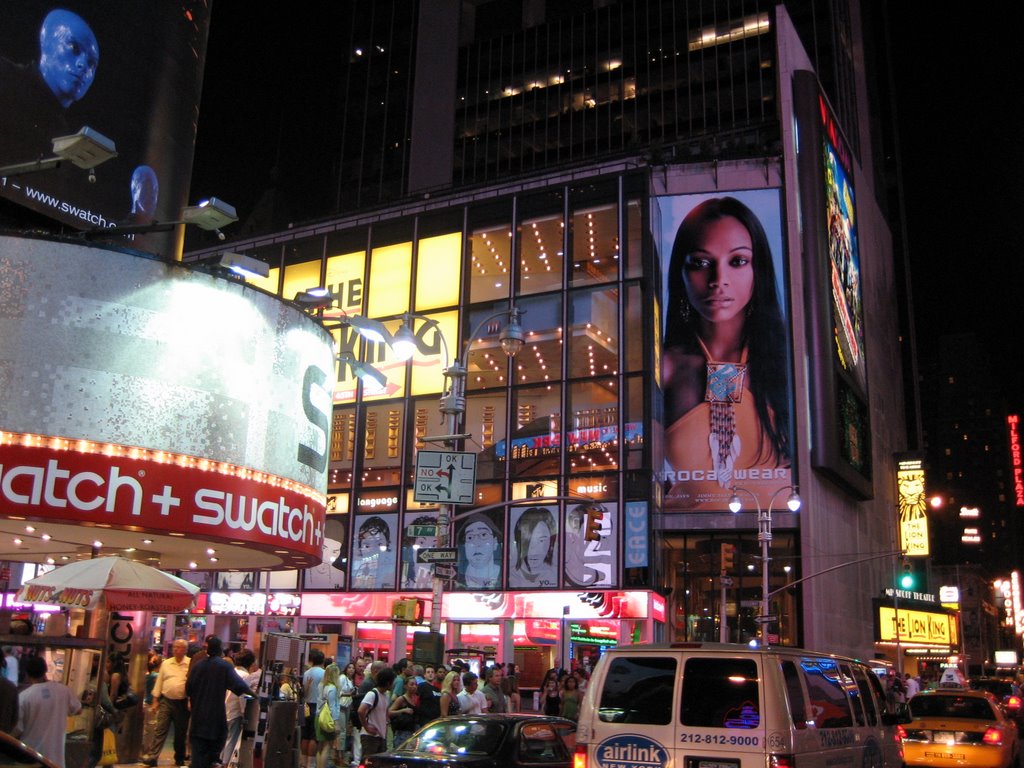
Perhaps this conglomeration of shapes, colors, and sundry 21st Century artifacts, may not be a product of carelessness, or haste; but it is "helter-skelter". This is the intersection of 42nd Street and 8th Avenue in New York City, part of what has turned this part of town into "city as theme park". Oh yes, helter-skelter is also a noun - a popular British amusement ride described to some degree in Lennon & McCartney's song by the same name. As adverb, adjective, or even noun, the name applies to this mish-mash, with rhythm perhaps, but with little sense. Do you agree?

Photo taken September, 2007; Canon PowerShot SD600.

Guanajuato Walls

What is so attractive about these old walls with the name Roja? I shot this in 1974 in Guanajuato, Mexico. For years it hung somewhere in my home, and I have never stopped looking at it and wondering why? What is really attracting me to this photo? Could it be the vertical rectangular layers? …the combinations of colors? …the third worldliness of it? …or could it be "Roja"? Who is, or was, Roja? A local politico, a common vandal, a kid making his mark, or just the female form of "rojo" - the color red? Some pictures have a way of lodging themselves in the subconscious, this is one of them. I hope it sticks to you as it has, pleasantly but hauntingly, stuck to me for over thirty-three years.

Shot with a Nikon F2, 105mm Nikkor lens, Ektachrome Professional film.

Sunday, May 06, 2007

Most men lead lives of quiet desperation ...

Sometimes the picture comes first and the thought follows. With this one, the quote from Henry David Thoreau had been bouncing in my head for a long time, and I couldn't find an image to express it. Rummaging through my photos, I found this one of a mannequin taken at a roadside antique shop in upstate New York. It seems appropriate to me for some reason. I have come to empathize with this unknown, unnamed, but price tagged mannequin.

“Most men lead lives of quiet desperation and go to the grave with the song still in them.” Henry David Thoreau (1817-1862)

Digital picture taken August 12, 2006 - Nikon D100

Saturday, October 14, 2006

Head in the Clouds

Remember the picture of the Ceiba tree in my hometown at the very bottom of the home page? Well this is, and has been, my hometown since I was ten. My dusty little hometown was where I developed my fascination with flying for there was an Air Force base just outside town, and we all had ringside seats for the best formation flying in the world. When I was little, back in San Antonio de los Baños, people used to tease me by telling me in New York the buildings were so tall that if you just touched them they would collapse. I believed them until I was eleven when one day I walked past the Empire State Building, and when no one was looking, I gave it gentle shove. Today I fly my small plane around this remarkable island, but not on a day like this.

Picture taken 10/1/06 Posted by Picasa

Saturday, September 30, 2006

Ularoo - Uluru - Ayer's Rock


Exquisite timeless beauty.

Free from the past with a view of future wonders. Must not let the mind slip to the past... but use it as the basis of all that lies ahead.


South East corner of Ayer's Rock before sunset - January 24, 1999
Photo is unaltered. Posted by Picasa

Wednesday, September 27, 2006

Blogger's block

What can I tell you, I’m suffering from a severe case of blogger’s block. It is just like writer’s block, only that it happens in public and when the only deadlines are your own.

The funny thing is that this is happening when I have all the time in the world. I’m home recuperating from back surgery. I have next to nothing to do and yet I can’t bring myself to publishing a cohesive blog. It’s not for a lack of ideas or pictures; it’s a lack of will. I always thought publishing a personal blog like this was nothing but a symptom of terminal boredom, but I’m not bored, or busy, or lonely, or disabled, or unsocial, or depressed …well, maybe just a little and a bit achy from the surgery. All I know is that I am suffering from a severe case of mental constipation. Maybe it’s all the medications I’m taking. What do you think?

Monday, September 18, 2006

...be prepared to burrow deep for a deep winter

I recently had to visualize a poem by David Wagoner. Visualizing poetry is always a very difficult, if not impossible, task. But that is what I'm hired for. This poem proved to be particularly challenging. What is Wagoner really saying? I chose to end it with this picture. Of course the client didn't go for it - too morbid, but then, what is this poem really all about? Hum?

STAYING ALIVE

By David Wagoner

Staying alive in the woods is a matter of calming down
At first and deciding whether to wait for rescue,
Trusting to others,
Or simply to start walking and walking in one direction
Till you come out—or something happens to stop you.
By far the safer choice
Is to settle down where you are, and try to make a living
Off the land, camping near water, away from shadows.

Eat no white berries;
Spit out all bitterness.
If you have no matches, a stick and a fire-bow
Will keep you warmer,
Or the crystal of your watch, filled with water, held up to the sun
Will do the same in time. In case of snow
Drifting toward winter,
Don’t try to stay awake through the night, afraid of freezing—
The bottom of your mind knows all about zero;
It will turn you over
And shake you till you waken.

If you hurt yourself, no one will comfort you
Or take your temperature,
So stumbling, wading, and climbing are as dangerous as flying.
But if you decide, at last, you must break through
In spite of all danger,
Think of yourself by time and not by distance, counting
Wherever you’re going by how long it takes you;
No other measure
Will bring you safe to nightfall. Follow no streams: they run
Under the ground or fall into wilder country.
Remember the stars
And moss when your mind runs into circles. If it should rain
Or the fog should roll the horizon in around you,
Hold still for hours
Or days if you must, or weeks, for seeing is believing
In the wilderness. And if you find a pathway,
Wheel, rut, or fence, wire,
Retrace it left or right: someone knew where he was going
Once upon a time, and you can follow
Hopefully, somewhere,
Just in case. There may even come, on some uncanny evening,
A time when you’re warm and dry, well fed, not thirsty,
Uninjured, without fear,
When nothing, either good or bad, is happening.
This is called staying alive. It’s temporary.

What occurs after
Is doubtful. You must always be ready for something to come bursting
Through the far edge of a clearing, running toward you,
Grinning from ear to ear
And hoarse with welcome. Or something crossing and hovering
Overhead, as light as air, like a break in the sky,
Wondering what you are.

Here you are face to face with the problem of recognition.
Having no time to make smoke, too much to say,
You should have a mirror
With a tiny hole in the back for better aiming, for reflecting
Whatever disaster you can think of, to show
The way you suffer.

These body signals have universal meaning: If you are lying
Flat on your back with arms outstretched behind you,
You say you require
Emergency treatment; if you are standing erect and holding
Arms horizontal, you mean you are not ready;
If you hold them over
Your head, you want to be picked up. Three of anything
Is a sign of distress. Afterward, if you see
No ropes, no ladders,
No maps or messages falling, no searchlights or trails blazing,
Then, chances are, you should be prepared to burrow
Deep for a deep winter.

Picture taken in Sag Harbor, NY - May 2006 Posted by Picasa

Monday, September 11, 2006

My thanks to Blog of the Day

I just got notice I have the honor of being today's Blog of the Day. Easier to get than an Emmy, and with fewer people watching. Thank you. I only wish I had a photo to go with gratitude. Just click on the title to go to that site.

It was on a Tuesday...

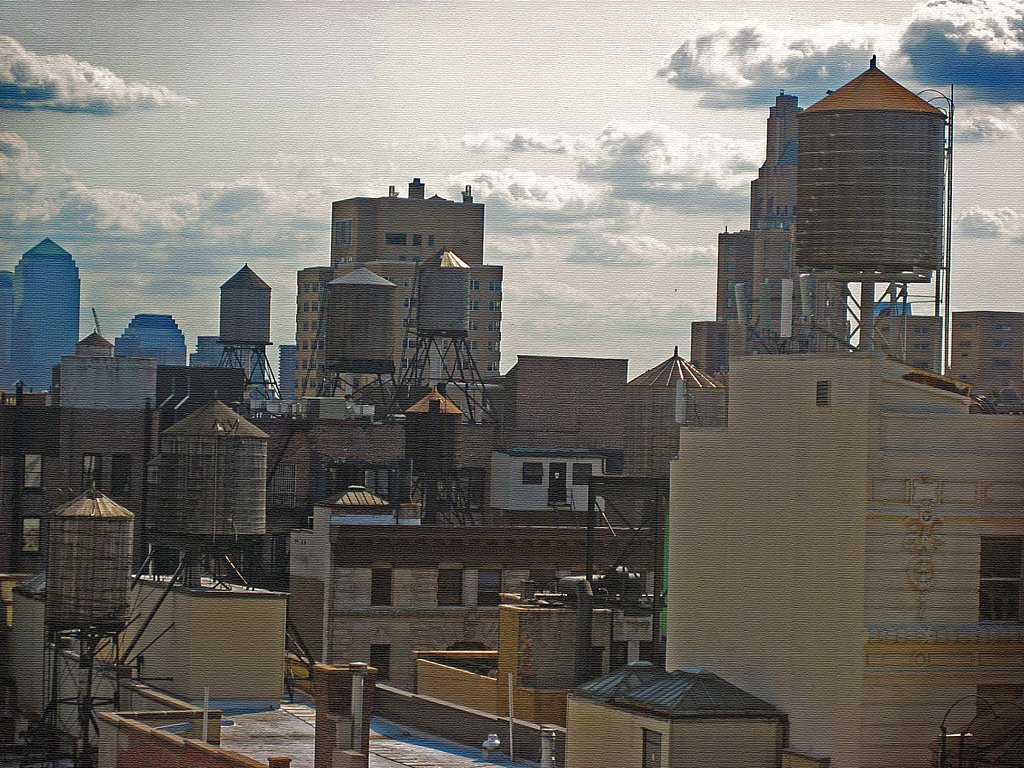
This is the view looking south from my office. New York is famous for the Empire State Building, the Statue of Liberty, and Wall Street. But there is a silent, unassuming symbol that, to me, represents this city more than any other. While other cities have tall buildings, statues, and famous streets, only New York has my loved wooden water tanks. It is possible here because ingenious civil engineers of the late 19th century built an aqueduct that works almost entirely on gravity. The city's water supply comes downhill for hundreds of miles and reaches, unaided, to the sixth floor of any building in Manhattan Island (water seeking its own level), after the sixth floor a little help is needed. That is where the tanks come in – it is much easier to slowly pump a little water up a small pipe and store it on the roof, than to pump water for the entire building. When the water is pumped up to the roof it stays there, stored in these hushed water tanks until gravity takes over again and down comes the water. If you look to the left of the picture you’ll see a building with a triangular top. It was behind that building that until a Tuesday in September five years ago two tall towers stood. It was on a Tuesday, and no matter what anyone says, this city has never been the same. I don’t know for sure, but I’d bet even those towers had water tanks hidden on the roof.

Photo taken July 7, 2006 Posted by Picasa

Friday, September 01, 2006

An Old Dog Discovers New Tricks

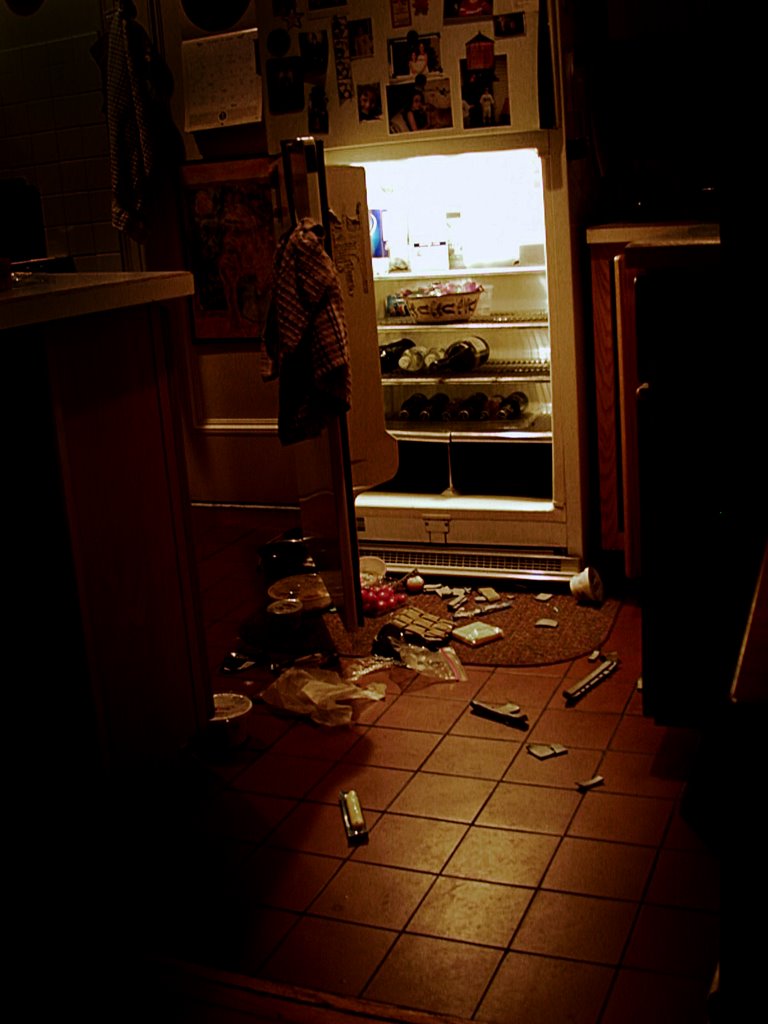
Perhaps it is true that you can't teach an old dog new tricks, but our 12 year old dog - Apples - "learned" on her own how to open our refrigerator and eat all the cheese, meat, yogurt, apple sauce, and anything she could smash or tear open. She never touched the salad. She learned this trick while we were all out of the house for the evening. The first few times this happened we unfairly attributed it to our typically distracted teenage son leaving the fridge open. It took a while for the reality to sink in – Apples had learned how to open the refrigerator. In time we found a way of locking it, but not before she ate us out of several meals.

March 2006 Posted by Picasa

Sunday, August 27, 2006

It's not the same without the horse.

What else can I say? One second he was there, beautifully framed, and then he wasn't. Posted by Picasa

"...till human voices wake us, and we drown."

End of T.S. Eliot's "The Love Song of J. Alfred Prufrock." The noise - visual, auditory, sensory, from all directions and origins - is so intense, our inner voice is drowing in a sea of distractions.

Times Square, New York
July 2006
Posted by Picasa

Wednesday, August 23, 2006

"This is the very dead of Summer"

The beginning of the "August" chapter from "The Twelve Seasons" (1949) by Joseph Wood Krutch.

New York State
August 2006
Posted by Picasa

Monday, August 21, 2006

A House Dreaming

An old house with dreams of grandeur, or maybe just pondering memories of times past.

Charlotteville, New York
August, 2006
Posted by Picasa

Waiting

...but the question is - for what ...or for whom?

One of the jobs of a director is scouting for appropriate sites to stage scenes. These beds presented themselves in passing. I wasn’t going to shoot there but they were creepy, especially when they were in a beauty spa.


Levittown, New York
June 22, 2006
Posted by Picasa

Standing Room Only

I looked up and there they were, just waiting for me to take their picture.

Some images are startling in unusual ways. Why should a group of nondescript buildings present a surprise? It could be the angle, the lighting, the design, any number of disparate things. This particular image was startling to me because of the anthropomorphic qualities that immediately struck me when I looked up from an empty lot while waiting for the attendant to bring my parked car. For a fleeting moment I was a little kid afraid of the old water tank looming over me.


New York City
June 21, 2006
Posted by Picasa

Saturday, February 25, 2006

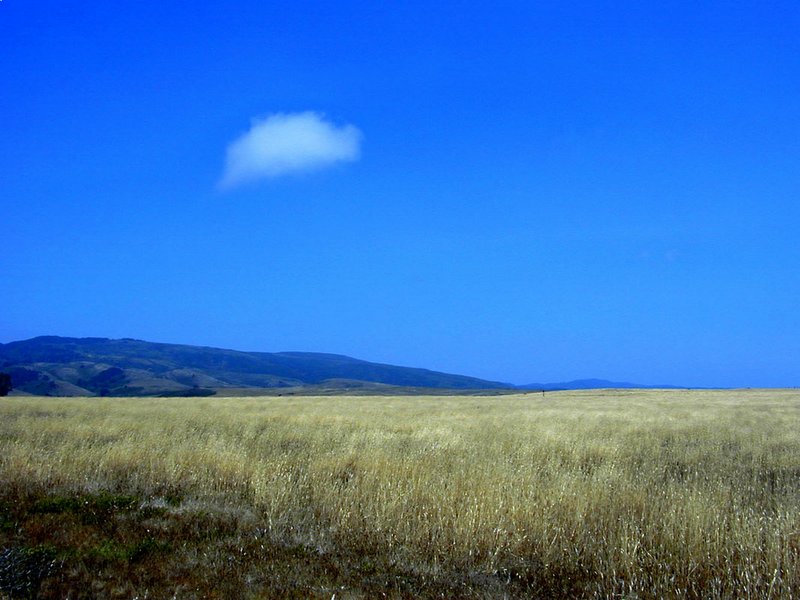
"I wandered lonely as a cloud..."

The line from William Wordsworth's poem took on new meaning for me when I saw this wayward puff, even without the daffodils.

For a 21st Century update of this poem, go here.
Posted by Picasa


Point Reyes, California; July 2004

Thursday, February 23, 2006

A cherished childhood friend.


July 2000

This is an iconic memory from my distant past. The big "ceiba" tree I knew from infancy is still there, and my hometown never looked smaller. This tree goes back to a time when my grandparents were children and earlier. My grandfather used to tell the story when the guys would gather around the ceiba on Sunday afternoons and engage in gas passing contests. My father remembered a big breasted African woman who would sit on one of the tree’s mammoth roots and breast feed neighborhood children for free or a small fee. I returned to my hometown after 41 years, with my then 12 year old son, my wife who had never been to Cuba, and my mom for whom the town also looked small and the people had not changed at all. My hometown is not far from La Habana; a dusty little town called San Antonio de los Baños. Posted by Picasa

Sunday, January 23, 2005

When you run out of drawers, you store it on the web.

 
Page Strength SEO Tool - SEOmoz.org